
View my complete CV: cmd CV
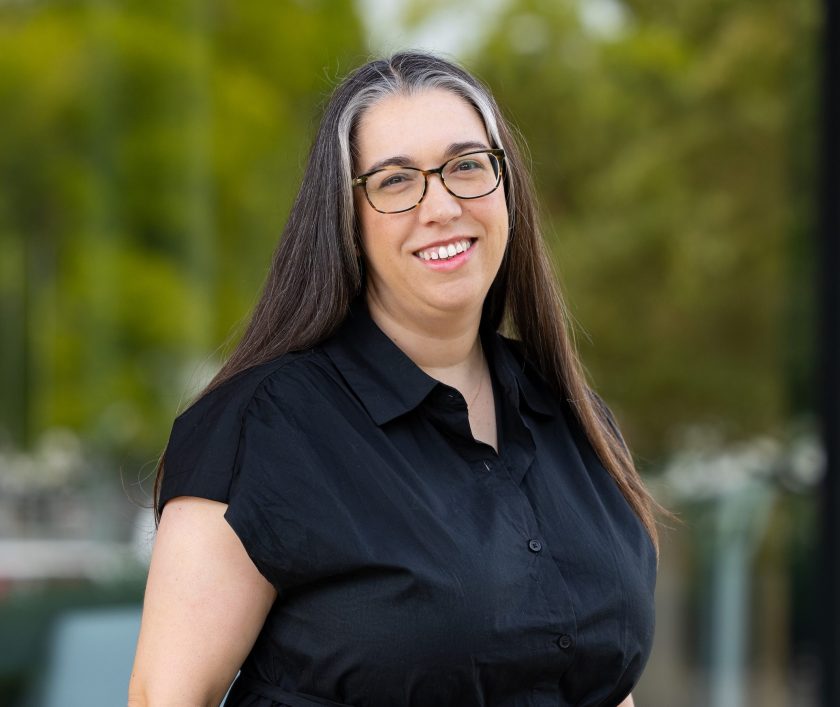
Cynthia D’Angelo, Ph.D. is currently a tenured Associate Professor at the University of Illinois Urbana-Champaign. She has a split appointment within the College of Education; 75% in the Educational Psychology department and 25% in the Curriculum and Instruction department. She has a background in physics and science education. Her research is focused at the intersection of science education, technology-enhanced learning environments (including simulations and games), learning analytics, and collaborative learning. Her work leverages data gathered through online technologies to better understand student learning of STEM concepts and practices and help teachers improve their instruction. One strand of her work focuses on utilizing multi-modal learning analytics, usually involving classroom audio data, to better understand and model learning and teaching in authentic settings. Her other strand of work focuses on developing and studying innovative and immersive forms of simulations for science learning, including virtual and augmented reality applications and gesture-based interfaces for simulations.
Before coming to the University of Illinois, she was a senior researcher with the Center for Technology in Learning at SRI International in Menlo Park, CA (from 2012 to 2018). At SRI, she worked on a wide variety of projects, mostly focused on science education, technology-enhanced learning, and assessment.
Previously, she was a post doc and the Research Director of the Epistemic Games Group at the University of Wisconsin – Madison working with David Williamson Shaffer. She has a background in physics and science education. Cynthia has always been interested in improving science instruction and most recently, using simulations and games to help facilitate learning in science domains. Among other things, she is interested in finding new ways of visualizing complex data streams from online learning environments and in how students make use of multimedia representations of scientific concepts in games. Her dissertation work at Arizona State University with Douglas Clark involved looking at how students’ understanding of vectors, vector addition, and Newtonian mechanics was mediated by representations and scaffolding questions in a specially designed physics game called SURGE.
Education
- Ph.D. Science Education, Arizona State University, 2010
- M.S. Physics, Arizona State University, 2007
- B.S. Physics/Astrophysics, University of California at San Diego, 2003
Appointments
- Associate Professor, University of Illinois Urbana-Champaign, 2025 – present
- Assistant Professor, University of Illinois Urbana-Champaign, 2018 – 2025
- Senior Researcher, SRI International, 2016 – 2018
- Education Researcher, SRI International, 2012 – 2016
- Postdoctoral Fellow, University of Wisconsin – Madison, 2010-2012
Selected External Grants
- Understanding and Addressing the Complex STEM Learning Challenges of Adults with Type 1 Diabetes. Principal Investigator. National Science Foundation. #DRL-2517090, program: Advancing Informal STEM Learning (AISL). ). $1,199,999. 9/15/2025 – 8/31/2029.
- Advancing Computational Grounded Theory for Audiovisual Data from STEM Classrooms. Co-Principal Investigator. National Science Foundation. #DRL-1920796, program: EHR Core Research (ECR). $1,313,855. 9/1/19 – 8/31/22.
- Speech-Based Learning Analytics for Collaboration. National Science Foundation #DRL-1432606, programs: Education Core Research (ECR) and Cyberlearning. D’Angelo: PI. $1,499,944. 9/1/14 – 8/31/17. project page
- CAP: Building Partnerships for Education and Speech Research. National Science Foundation #IIS-1550800, programs: Cyberlearning and DRK-12. D’Angelo: Co-PI. $49,996 (sub-award through The Concord Consortium). 9/1/15 – 8/31/16.
Honors and Awards
- Honorable Mention – Short Paper, Learning Analytics and Knowledge conference, 2023
- NSF Community for Advancing Discovery Research in Education (CADRE) Fellow, 2009-2010
- Outstanding Paper Award, International Conference of the Learning Sciences, 2008
Selected Publications and Presentations (For a complete list, please see the above linked CV file.)
- D’Angelo, C. M. & Rajarathinam, R. J. (2024). Speech analysis of teaching assistant interventions in small group collaborative problem solving with undergraduate engineering students. British Journal of Educational Technology, 55(4), 1583–1601. doi.org/10.1111/bjet.13449
- Worsley, M., Martinez-Maldonado, R., & D’Angelo, C. (2021). A new era in multimodal learning analytics: Twelve core commitments to ground and grow MMLA. Journal of Learning Analytics, 1-18. doi.org/10.18608/jla.2021.7361
- Wilkerson, M., D’Angelo, C., & Litts, B. (2020). Stories from the field: Locating and cultivating computational thinking in spaces of learning. Interactive Learning Environments, 28(3), 264-271. doi.org/10.1080/10494820.2020.1711326
- D’Angelo, C. M., Smith, J., Alozie, N., Tsiartas, A., Richey, C., & Bratt, H. (2019). Mapping individual to group level collaboration indicators using speech data. In Lund, K., Niccolai, G., Lavoué, E., Hmelo-Silver, C., Gweon, G., & Baker, M. (Eds). A Wide Lens: Combining Embodied, Enactive, Extended, and Embedded Learning in Collaborative Settings: 13th International Conference on Computer Supported Collaborative Learning. Lyon, France: International Society of the Learning Sciences.
- D’Angelo, C. M., Harris, C. J., Lundh, P., House, A., Leones, T, & Llorente, C. (2017). Found science: Examining the types, features, and use of instructional materials in afterschool science. School Science and Mathematics, 117, 269–281.
- Krumm, A. E., Beattie, R., Takahashi, S., D’Angelo, C., Feng, M., & Cheng, B. (2016). Practical measurement and productive persistence: Strategies for using digital learning system data to drive improvement. Journal of Learning Analytics, 3(2), 116-138.
- D’Angelo, C. M., Roschelle, J., Bratt, H., Shriberg, L., Richey, C., Tsiartas, A., & Alozie, N. (2015). Using students’ speech to characterize group collaboration quality. Poster presented at The Computer Supported Collaborative Learning (CSCL) Conference 2015. Gothenburg, Sweden.
- Harris, C. J., Penuel, W. R., D’Angelo, C. M., DeBarger, A. H., Gallagher, L. P., Kennedy, C. A., & Cheng, B. (2015). Impact of project-based curriculum materials on student learning in science: Results of a randomized controlled trial. Journal of Research in Science Teaching, 52(10), 1362-1385.
- D’Angelo, C. M., Moorthy, S., Allen Bemis, C., & Sherwood, C. A. (2014). Using log data to analyze teacher implementation of Framework-aligned curriculum. Paper presented at the NARST annual international conference. Pittsburgh, PA.
- Clark, D. B., Menekse, M., Ozdemir, G., D’Angelo, C. M., & Schleigh, S. (2014). Exploring sources of variation in studies of knowledge structure coherence: Comparing force meanings and force meaning consistency across two Turkish cities. Science Education, 98(1), 143-191.
- D’Angelo, C. M., Harris, C. J., & Rutstein, D. (2013). Systematic Review and Meta-Analysis of STEM Simulations. Proceedings of the Tenth International Conference on Computer-Supported Collaborative Learning. Madison, WI.
- Chesler, N. C., Arastoopour, G., D’Angelo, C. M., Bagley, E. B., & Shaffer, D. W. (2013). Design of a professional practice simulator for educating and motivating first year engineering students. Advances in Engineering Education, 3(3), 1-29.
- D’Angelo, C. M. (2012). Land Science: Assessing student discourse in games with Epistemic Network Analysis. Presented at the National Council for Measurement in Education Annual Conference. Vancouver, Canada.
- D’Angelo, C M., Clark, D. B., & Shaffer, D. W. (2012). Epistemic Network Analysis: An alternative analysis technique for complex STEM thinking. Paper presented at the National Association for Research in Science Teaching Annual International Conference. Indianapolis, IN.
- D’Angelo, C. M., Arastoopour, G., Chesler, N.C., & Shaffer, D. W. (2011). Collaborating in a virtual engineering internship. Proceedings of the Ninth International Conference on Computer-Supported Collaborative Learning. Hong Kong, Hong Kong S.A.R.
- Clark, D. B., D’Angelo, C. M., & Schleigh, S. P. (2011). Comparison of students’ knowledge and understanding of force in the Philippines, Turkey, China, Mexico, and the United States. Journal of the Learning Sciences, 20(2), 207 – 261.
- Clark, D. B., Nelson, B., Chang, H. Y., Slack, K., Martinez-Garza, M., & D’Angelo, C. M. (2011). Exploring Newtonian mechanics in a conceptually-integrated digital game: Comparison of learning and affective outcomes for students in Taiwan and the United States. Computers and Education, 57(3), 2178-2195.
- D’Angelo, C. M. (2010). Scaffolding vector representations for student learning inside a physics game. Unpublished doctoral dissertation, Arizona State University.
- Clark, D. B., Nelson, B., Sengupta, P., D’Angelo, C. M. (2009). Rethinking Science Learning Through Digital Games and Simulations: Genres, Examples, and Evidence. Invited Topic Paper in the Proceedings of The National Academies Board on Science Education Workshop on Learning Science: Computer Games, Simulations, and Education. Washington, D.C.

